|
|
|
|
|
|
|
|||
|
INTRODUCTION |
TYPES OF MEMORY |
MEMORY PROCESSES |
MEMORY DISORDERS |
MEMORY & THE BRAIN |
SOURCES & REFERENCES |

|
|
NEURONS & SYNAPSES
The average human brain has about 100 billion neurons (or nerve cells) and many more neuroglia (or glial cells) which serve to support and protect the neurons (although see the end of this page for more information on glial cells). Each neuron may be connected to up to 10,000 other neurons, passing signals to each other via as many as 1,000 trillion synaptic connections, equivalent by some estimates to a computer with a 1 trillion bit per second processor. Estimates of the human brain’s memory capacity vary wildly from 1 to 1,000 terabytes (for comparison, the 19 million volumes in the US Library of Congress represents about 10 terabytes of data).
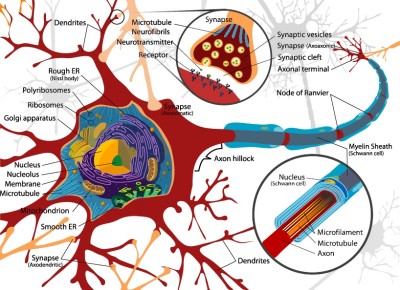
A typical neuron possesses a soma (the bulbous cell body which contains the cell nucleus), dendrites (long, feathery filaments attached to the cell body in a complex branching “dendritic tree”) and a single axon (a special, extra-long, branched cellular filament, which may be thousands of times the length of the soma). Every neuron maintains a voltage gradient across its membrane, due to metabolically-driven differences in ions of sodium, potassium, chloride and calcium within the cell, each of which has a different charge. If the voltage changes significantly, an electrochemical pulse called an action potential (or nerve impulse) is generated. This electrical activity can be measured and displayed as a wave form called brain wave or brain rhythm.
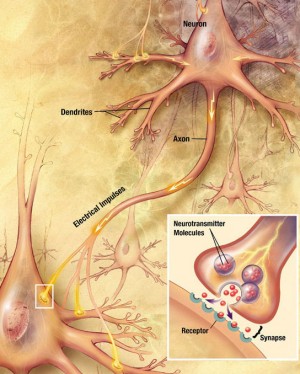
This pulse travels rapidly along the cell's axon, and is transferred across a specialized connection known as a synapse to a neighbouring neuron, which receives it through its feathery dendrites. A synapse is a complex membrane junction or gap (the actual gap, also known as the synaptic cleft, is of the order of 20 nanometres, or 20 millionths of a millimetre) used to transmit signals between cells, and this transfer is therefore known as a synaptic connection. Although axon-dendrite synaptic connections are the norm, other variations (e.g. dendrite-dendrite, axon-axon, dendrite-axon) are also possible. A typical neuron fires 5 - 50 times every second. Each individual neuron can form thousands of links with other neurons in this way, giving a typical brain well over 100 trillion synapses (up to 1,000 trillion, by some estimates). Functionally related neurons connect to each other to form neural networks (also known as neural nets or assemblies). The connections between neurons are not static, though, they change over time. The more signals sent between two neurons, the stronger the connection grows (technically, the amplitude of the post-synaptic neuron’s response increases), and so, with each new experience and each remembered event or fact, the brain slightly re-wires its physical structure. The interactions of neurons is not merely electrical, though, but electro-chemical. Each axon terminal contains thousands of membrane-bound sacs called vesicles, which in turn contain thousands of neurotransmitter molecules each. Neurotransmitters are chemical messengers which relay, amplify and modulate signals between neurons and other cells. The two most common neurotransmitters in the brain are the amino acids glutamate and GABA; other important neurotransmitters include acetylcholine, dopamine, adrenaline, histamine, serotonin and melatonin.
The electro-chemical signal released by a particular neurotransmitter may be such as to encourage to the receiving cell to also fire, or to inhibit or prevent it from firing. Different neurotransmitters tend to act as excitatory (e.g. acetylcholine, glutamate, aspartate, noradrenaline, histamine) or inhibitory (e.g. GABA, glycine, seratonin), while some (e.g. dopamine) may be either. Subtle variations in the mechanisms of neurotransmission allow the brain to respond to the various demands made on it, including the encoding, consolidation, storage and retrieval of memories. As has been mentioned, in addition to neurons, the brain contains about an equal mass of glial cells (neuroglia or simply glia), the most common types being oligodendrocytes, astrocytes and microglia. Because they are so much smaller than neurons, there are up to 10 times as many in number, and different areas of the brain have higher or lower concentrations of glia. It used to be thought that the role of glial cells was limited to the physical support, nutrition and repair of the neurons of the central nervous system. However, more recent research suggests that glia, particularly astrocytes, actually perform a much more active role in brain communication and neuroplasticity, although the extent and mechanics of of this role is still uncertain, and a substantial amount of contemporary brain research is now focused on glials cells. Back to Top of Page Home | Contact | Search Introduction | Types of Memory | Memory Processes | Memory Disorders | Memory & the Brain | Sources & References |
|
memory, human memory, types of memory, memory processes, how memory works, how human memory works
|